What Is a Calorie Deficit?
If you have ever tried to lose weight, you have probably heard the term “calorie deficit.” But what does it actually mean? And more importantly, how do you create one without feeling hungry, tired, and miserable?
Here is the truth: every single successful weight loss journey — whether through keto, intermittent fasting, veganism, or simple portion control — works for one reason and one reason only. They all create a calorie deficit.
You do not need to cut out entire food groups, buy expensive supplements, or spend hours meal prepping complicated recipes. You just need to understand one simple equation.
In this guide, you will learn:
- Exactly what a calorie deficit is (in plain English)
- How to calculate your personal deficit number
- The safe deficit range that preserves muscle
- Why most people get it wrong (and how to avoid their mistakes)
- How to lose weight without feeling like you are starving
Let us dive in.
What Is a Calorie Deficit? The Simple Definition
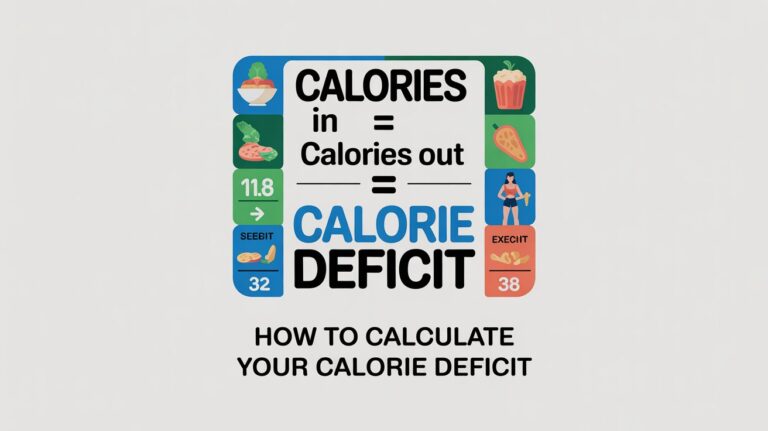
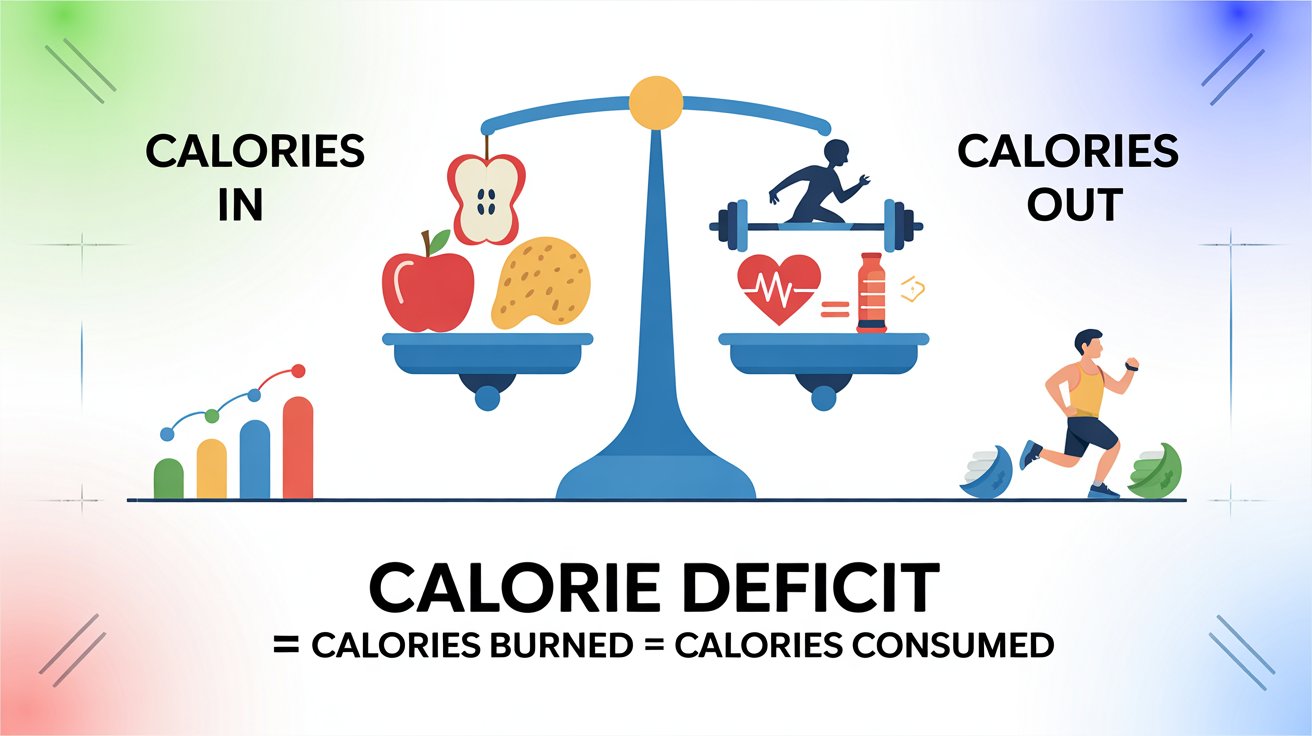
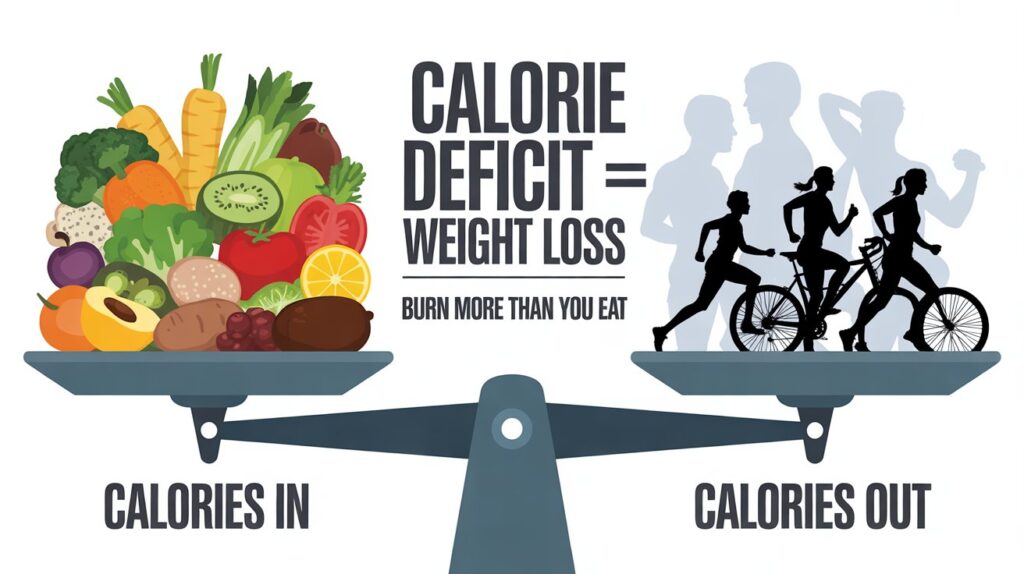
A calorie deficit occurs when you consume fewer calories than your body burns in a day.
Think of your body like a smartphone. Every function — breathing, walking, thinking, digesting, exercising — uses energy (calories). That energy comes from the food and drink you consume.
| Your Body’s Energy Budget | What It Means |
|---|---|
| Calories In | Everything you eat and drink |
| Calories Out | Everything your body burns (breathing, digestion, movement, exercise) |
| Calorie Deficit | Calories In < Calories Out |
| Calorie Surplus | Calories In > Calories Out |
| Calorie Maintenance | Calories In = Calories Out |
When you are in a deficit, your body has no choice but to tap into its stored energy reserves — also known as body fat — to keep functioning. That is weight loss.
When you are in a surplus, your body stores the extra energy as fat for future use. That is weight gain.
Coach’s note: This is not a theory or a diet trend. It is the first law of thermodynamics applied to the human body. Every diet that has ever worked — from Weight Watchers to Atkins to plant-based — works because it helps you eat fewer calories than you burn.
The Science: What Happens to Your Body in a Calorie Deficit
Understanding what happens inside your body makes the process less mysterious and more manageable.
Step 1: Your Body Burns Available Energy
When you eat a meal, your body first uses the calories from that food for immediate energy. Any excess is stored as glycogen (short-term storage in your liver and muscles) or fat (long-term storage).
Step 2: Your Body Taps Into Stored Fat
When you are in a deficit and your immediate energy runs out, your body releases hormones (like glucagon) that signal fat cells to release stored energy. This fat is broken down into fatty acids and used as fuel.
Step 3: You Lose Weight
As fat cells release their stored energy, they shrink. This is visible on the scale and in the mirror.
Step 4: Your Body Adapts (The Plateau Risk)
After several weeks in a deficit, your body senses an energy shortage and adapts. It lowers your metabolic rate slightly (adaptive thermogenesis) and increases hunger hormones (ghrelin). This is why plateaus happen — and why sustainable deficits matter.
| Phase | What Happens | Duration |
|---|---|---|
| Weeks 1-2 | Rapid weight loss (mostly water) | Normal |
| Weeks 3-8 | Steady fat loss (0.5-1kg per week) | Ideal |
| Weeks 8-12 | Possible metabolic adaptation begins | Time for a diet break |
| Week 12+ | Plateau risk increases | Recalculate or take a break |
How to Calculate Your Personal Calorie Deficit
Creating a calorie deficit starts with knowing your numbers. Here is the step-by-step process.
Step 1: Calculate Your BMR (Basal Metabolic Rate)
Your BMR is the number of calories your body burns at complete rest — just to keep you alive. Use the Mifflin-St Jeor formula:
| Gender | Formula |
|---|---|
| Male | (10 × weight in kg) + (6.25 × height in cm) – (5 × age) + 5 |
| Female | (10 × weight in kg) + (6.25 × height in cm) – (5 × age) – 161 |
Example for a 35-year-old woman, 70kg, 165cm:
- BMR = (10 × 70) + (6.25 × 165) – (5 × 35) – 161
- BMR = 700 + 1,031 – 175 – 161
- BMR = 1,395 calories per day
Step 2: Calculate Your TDEE (Total Daily Energy Expenditure)
Multiply your BMR by an activity factor that matches your lifestyle.
| Activity Level | Multiplier | Example |
|---|---|---|
| Sedentary (desk job, no exercise) | BMR × 1.2 | 1,395 × 1.2 = 1,674 calories |
| Lightly active (exercise 1-3 days/week) | BMR × 1.375 | 1,395 × 1.375 = 1,918 calories |
| Moderately active (exercise 3-5 days/week) | BMR × 1.55 | 1,395 × 1.55 = 2,162 calories |
| Very active (exercise 6-7 days/week) | BMR × 1.725 | 1,395 × 1.725 = 2,406 calories |
| Super active (physical job + daily exercise) | BMR × 1.9 | 1,395 × 1.9 = 2,650 calories |
Your TDEE is your maintenance calories. Eat this amount, and your weight stays the same.
Step 3: Choose Your Deficit Size
Subtract calories from your TDEE based on your goal and timeline.
| Deficit Size | Weekly Loss | Best For |
|---|---|---|
| 250 calories/day | 0.25 kg (0.5 lb) | Beginners, close to goal weight, minimal hunger |
| 500 calories/day | 0.5 kg (1 lb) | Most people — sustainable and effective |
| 750 calories/day | 0.75 kg (1.5 lb) | Aggressive but manageable with high protein |
| 1000 calories/day | 1 kg (2 lb) | Very aggressive — short-term only |
Example using our 35-year-old woman (TDEE 2,162):
| Goal | Daily Calories | Deficit |
|---|---|---|
| Maintenance | 2,162 | 0 |
| Mild weight loss | 1,912 | 250 calories |
| Moderate weight loss | 1,662 | 500 calories |
| Aggressive weight loss | 1,412 | 750 calories |
Step 4: Never Go Below Safe Minimums
| Group | Absolute Minimum | Why |
|---|---|---|
| Women | 1,200 calories/day | Below this risks nutrient deficiencies, muscle loss, hormonal disruption |
| Men | 1,500 calories/day | Below this risks metabolic slowdown, fatigue, gallstones |
If your calculated deficit would push you below these numbers, extend your timeline. Weight loss is a marathon, not a sprint.
What Is a Safe Calorie Deficit? The Evidence-Based Range
A safe calorie deficit is one that produces steady fat loss while preserving muscle mass, energy levels, and metabolic health.
The safe range: 300 to 750 calories below your TDEE
This range is supported by the NHS, the British Dietetic Association, and decades of weight loss research.
| Deficit Size | Pros | Cons |
|---|---|---|
| 300-400 calories | Easy to maintain, minimal hunger, preserves muscle | Slower results (0.3-0.4kg per week) |
| 400-600 calories | Sweet spot — good results, manageable | Requires consistent tracking |
| 600-750 calories | Faster results (0.6-0.8kg per week) | Higher hunger, risk of burnout |
| 750-1000 calories | Very fast loss (up to 1kg per week) | Hard to sustain, muscle loss risk |
| 1000+ calories | Medically supervised only | Dangerous without oversight |
What the research says:
A 2017 study published in the American Journal of Clinical Nutrition followed two groups over 12 months. One group used a 500-calorie daily deficit. The other used a more aggressive 750-calorie deficit. Results?
- Both groups lost significant weight
- The 500-calorie group had better adherence (85% vs 62%)
- The 500-calorie group regained less weight at 12-month follow-up
- The 750-calorie group reported higher hunger and fatigue
Coach’s takeaway: Start with a 500-calorie deficit. It is the most researched, most effective, and most sustainable option for most people.
Calorie Deficit for Weight Loss: How Much Will You Lose?
Use this table to estimate your results based on your deficit.
| Your Daily Deficit | Weekly Fat Loss | Monthly Fat Loss | Yearly Fat Loss |
|---|---|---|---|
| 250 calories | 0.25 kg (0.5 lb) | 1 kg (2.2 lb) | 12 kg (26 lb) |
| 500 calories | 0.5 kg (1 lb) | 2 kg (4.4 lb) | 24 kg (53 lb) |
| 750 calories | 0.75 kg (1.65 lb) | 3 kg (6.6 lb) | 36 kg (79 lb) |
| 1000 calories | 1 kg (2.2 lb) | 4 kg (8.8 lb) | 48 kg (106 lb) |
Important notes on these numbers:
- Weight loss is not perfectly linear (water weight, hormones, stress affect daily scale readings)
- The first 1-2 weeks often show faster loss (water weight)
- As you get smaller, your TDEE drops — you may need to adjust your deficit
- Muscle gain can mask fat loss on the scale (take measurements too)
How to Create a Calorie Deficit Without Starving
This is the million-pound question. Here is exactly how to create a deficit that feels sustainable.
Method 1: Eat Less (The Diet Approach)
Reduce your portion sizes, choose lower-calorie options, and cut out liquid calories.
| Swap This | For This | Calories Saved |
|---|---|---|
| Regular soda (330ml) | Sparkling water | 140 calories |
| Latte with whole milk | Black coffee or tea | 120 calories |
| Large cheddar cheese sandwich | Chicken salad sandwich | 200 calories |
| Fish and chips (medium) | Grilled fish with vegetables | 400 calories |
| Chocolate bar (50g) | Apple or pear | 200 calories |
| Creamy pasta sauce | Tomato-based sauce | 150 calories |
Method 2: Move More (The Activity Approach)
Increase your daily movement without structured exercise.
| Activity | Calories Burned (30 min, 70kg person) |
|---|---|
| Walking (brisk pace) | 120-150 calories |
| Standing instead of sitting | 30-50 extra calories |
| Taking stairs (10 flights) | 40-60 calories |
| House cleaning (vigorous) | 130-160 calories |
| Gardening | 120-150 calories |
| Playing with kids (active) | 100-140 calories |
Method 3: Combine Both (The Smart Approach)
The most sustainable approach combines modest diet changes with increased movement.
Example daily plan for a 500-calorie deficit:
| Change | Calories |
|---|---|
| Skip the morning latte | -120 calories |
| Swap crisps for an apple at lunch | -150 calories |
| Walk 30 minutes at lunch | -130 calories |
| Choose grilled over fried for dinner | -100 calories |
| Total deficit | -500 calories |
Notice how no single change is drastic. You are not starving. You are not spending hours in the gym. You are just making smarter choices consistently.
Common Calorie Deficit Mistakes (And How to Avoid Them)
Most people fail at calorie deficits not because they lack willpower, but because they make these predictable mistakes.
Mistake 1: Cutting Too Aggressively
Eating 1,200 calories when your body needs 2,000 triggers intense hunger, fatigue, muscle loss, and eventually, binge eating.
The fix: Use a calculator to find your actual TDEE. Start with a 300-500 calorie deficit. You can always increase it later if needed.
Mistake 2: Forgetting Liquid Calories
Coffee drinks, alcohol, juice, smoothies, and even milk in tea add up. A single pint of beer (180 calories) plus a latte (120 calories) plus a glass of wine (150 calories) is 450 calories — almost a full day’s deficit.
The fix: Track all drinks for one week. You will likely be shocked. Replace high-calorie drinks with water, black coffee, or herbal tea.
Mistake 3: Eating Back Exercise Calories
Your activity level selection already accounts for your exercise. If you eat back your workout calories, you double-count and erase your deficit.
The fix: Do not add extra food on workout days unless you are an endurance athlete burning 800+ calories per session.
Mistake 4: Ignoring Portion Sizes
“Healthy” foods still have calories. A “handful” of nuts can be 200 calories. A “drizzle” of olive oil is 120 calories. A “small” avocado is 240 calories.
The fix: Measure portions for two weeks. Use a food scale or measuring cups. You do not have to do this forever — just long enough to recalibrate your eye.
Mistake 5: Not Recalculating After Weight Loss
Your TDEE at 80kg is higher than your TDEE at 70kg. If you keep eating the same calories, your deficit shrinks and eventually disappears.
The fix: Recalculate your numbers every 5kg (11lbs) of weight loss. Adjust your intake down by 50-100 calories.
Calorie Deficit Without Exercise: Is It Possible?
Yes — absolutely.
Weight loss is 70-80% diet and 20-30% movement. You can lose significant weight without any formal exercise.
| Approach | Deficit Source | Weekly Loss Potential |
|---|---|---|
| Diet only | Reduce food intake by 500 calories | 0.5 kg (1 lb) |
| Exercise only | Burn 500 calories through exercise | 0.5 kg (1 lb) — requires 45-60 min daily |
| Combined | Reduce food by 250 + burn 250 through movement | 0.5 kg (1 lb) — much easier |
The reality: Most people find it easier to create a deficit through diet changes alone. Exercise is fantastic for health, heart, mood, and muscle preservation — but it is not strictly necessary for weight loss.
If you have mobility issues, a busy schedule, or simply dislike exercise, focus on your diet. You can still reach your goal weight.
Signs Your Calorie Deficit Is Too Aggressive
A deficit should feel challenging but manageable. Here is how to know if you have gone too far.
| Symptom | What It Means | What To Do |
|---|---|---|
| Constant hunger | Deficit too large or protein too low | Add 200 calories or increase protein |
| Low energy, brain fog | Not enough carbohydrates or total calories | Add 200-300 calories |
| Irritability, mood swings | Blood sugar instability or extreme deficit | Reduce deficit size |
| Hair loss or brittle nails | Nutrient deficiency or severe deficit | See a GP immediately |
| No period (women) | Hormonal disruption | Increase calories, see a GP |
| Weight loss >1kg/week for 3+ weeks | Likely losing muscle | Add 200-300 calories |
| Obsessive thoughts about food | Psychological distress | Take a diet break or increase calories |
Coach’s note: If you experience any of these symptoms, you are not weak. Your body is sending you a signal. Listen to it. Add calories back slowly until symptoms resolve.
Calorie Deficit and Muscle Loss: How to Preserve Muscle
One of the biggest risks of a calorie deficit is losing muscle along with fat. Here is how to protect your hard-earned muscle.
Strategy 1: Keep Your Deficit Moderate
Aggressive deficits (750+ calories) increase muscle loss. Stick to 300-500 calories for most of your weight loss journey.
Strategy 2: Eat Enough Protein
| Your Goal | Recommended Protein (per kg body weight) |
|---|---|
| Minimal muscle preservation | 1.2-1.6 g/kg |
| Active weight loss | 1.6-2.2 g/kg |
| Bodybuilder cutting | 2.2-2.6 g/kg |
For an 80kg person, that is 130-175g of protein daily.
Strategy 3: Strength Train 2-3 Times Per Week
Resistance training tells your body “this muscle is essential, do not burn it for fuel.” Even 20-minute sessions twice weekly make a significant difference.
| Exercise | Sets | Reps |
|---|---|---|
| Squats or leg press | 3 | 10-15 |
| Push-ups or chest press | 3 | 8-12 |
| Rows or pull-downs | 3 | 10-15 |
| Plank | 3 | 30-60 seconds |
Strategy 4: Avoid Extremely Low Body Fat
The leaner you get, the harder your body fights to hold onto fat. Very low body fat percentages (under 10% for men, under 18% for women) come with significant metabolic and hormonal challenges.
Calorie Deficit Myths: What Not to Believe
Let us bust some common myths so you do not waste time on strategies that do not work.
Myth 1: “Starvation mode stops weight loss”
Truth: “Starvation mode” is real but overblown. Your metabolism does slow in a deficit — by 5-15% — but it does not stop completely. You will still lose weight, just more slowly.
Myth 2: “Eating after 8pm turns straight to fat”
Truth: Your body does not have a clock for calories. Total daily intake matters, not timing. Some people find eating later makes weight loss harder (snacking, poor sleep), but the calories themselves are not special.
Myth 3: “Some foods have negative calories”
Truth: Celery and other low-calorie foods still have positive calories. The thermic effect of food (calories burned digesting) is never more than 20-30% of the food’s calories. Nothing you eat burns more calories than it provides.
Myth 4: “You can target fat loss (spot reduction)”
Truth: You cannot choose where your body loses fat first. Genetics dictate the order. For most people, the face and chest lose first; hips and belly lose last. Keep going — the stubborn areas will eventually respond.
Myth 5: “A calorie deficit works for everyone”
Truth: A calorie deficit works for almost everyone, but medical conditions (hypothyroidism, PCOS, Cushing’s, certain medications) can make weight loss significantly harder. If you are in a measured deficit for 4+ weeks with zero results, see your GP.
How to Start Your Calorie Deficit Today
Ready to begin? Here is your 7-day action plan.
Days 1-3: Track Everything
- Eat normally, but track every calorie using an app
- Do not try to change anything yet
- Learn where your calories actually come from
Days 4-5: Calculate Your Numbers
- Use our calculator to find your TDEE
- Subtract 500 calories for your target
- Plan your meals around your target
Days 6-7: Implement Your Deficit
- Eat at your target for two days
- Prioritise protein at every meal
- Drink 2-3 litres of water daily
Week 2 and Beyond: Adjust and Repeat
- Weigh yourself weekly (same day, same time, same scale)
- If you lost 0.5-1kg, keep going
- If you lost less, lower intake by 100 calories
- If you lost more or feel terrible, raise intake by 100 calories
- Recalculate every 5kg lost
The Bottom Line: What Is a Calorie Deficit?
A calorie deficit is simply eating fewer calories than your body burns. It is the fundamental mechanism behind every successful weight loss journey.
The key takeaways:
- Calculate your numbers — Use a TDEE calculator to find your maintenance calories
- Choose a safe deficit — 300-500 calories per day works for most people
- Never go below minimums — 1,200 for women, 1,500 for men without medical supervision
- Prioritise protein — Preserves muscle and controls hunger
- Track honestly — At least for the first few weeks
- Be patient — 0.5kg per week is excellent progress
- Recalculate regularly — Every 5kg lost, your needs change
Weight loss does not have to be complicated. You do not need to cut out entire food groups or spend hours meal prepping. You just need to understand your numbers, make small consistent changes, and trust the process.
🔥 Calorie Deficit: Frequently Asked Questions
A calorie deficit occurs when you consume fewer calories than your body burns in a day. Think of it like a budget: your body spends energy (calories out) on breathing, digestion, walking, and exercise. You provide energy through food (calories in). When calories in are less than calories out, your body taps into stored fat for fuel — and you lose weight.
Calculating your calorie deficit involves three simple steps:
Step 1: Find your BMR (Basal Metabolic Rate)
Use the Mifflin-St Jeor formula — the most accurate equation validated by research:
👩 Female: (10 × weight in kg) + (6.25 × height in cm) – (5 × age) – 161
Step 2: Find your TDEE (Total Daily Energy Expenditure)
Multiply your BMR by your activity level:
| Activity Level | Multiplier |
|---|---|
| Sedentary (desk job, no exercise) | BMR × 1.2 |
| Lightly active (exercise 1-3 days/week) | BMR × 1.375 |
| Moderately active (exercise 3-5 days/week) | BMR × 1.55 |
| Very active (exercise 6-7 days/week) | BMR × 1.725 |
| Super active (physical job + daily exercise) | BMR × 1.9 |
Step 3: Subtract 300-500 calories
Your TDEE is maintenance. Subtract 300-500 for a safe, effective deficit.
A safe calorie deficit ranges from 300 to 750 calories below your TDEE. This range is supported by the NHS and the British Dietetic Association.
| Deficit Size | Weekly Loss | Best For |
|---|---|---|
| 300-400 calories | 0.3-0.4 kg | Beginners, close to goal weight, minimal hunger |
| 400-600 calories | 0.4-0.6 kg | Most people — the sweet spot |
| 600-750 calories | 0.6-0.8 kg | Aggressive but manageable with high protein |
| 750-1000 calories | 0.75-1 kg | Very aggressive — short-term only |
Women: 1,200 calories/day | Men: 1,500 calories/day
Our recommendation: Start with a 500-calorie deficit. It is the most researched, most effective, and most sustainable option for most people.
No — absolutely not. Weight loss is 70-80% diet and 20-30% movement. You can lose significant weight without any formal exercise.
| Approach | Deficit Source | Weekly Loss Potential |
|---|---|---|
| Diet only | Reduce food intake by 500 calories | 0.5 kg (1 lb) |
| Exercise only | Burn 500 calories through exercise | 0.5 kg — requires 45-60 min daily |
| Combined | Reduce food by 250 + burn 250 | 0.5 kg — much easier |
An excessively large calorie deficit (typically 1,000+ calories below TDEE) triggers several negative adaptations:
- Muscle loss: 20-30% of weight lost can be muscle, not fat
- Metabolic adaptation: Your BMR drops 15-30% more than expected
- Intense hunger: Ghrelin (hunger hormone) spikes
- Fatigue and brain fog: Not enough fuel for basic functions
- Hormonal disruptions: Irregular periods (women), low testosterone (men)
- Gallstones: Rapid loss increases risk by 5-10x
- Rebound weight gain: 80-95% regain within 1-2 years
The amount of weight you lose depends on your deficit size. Here is the math:
| Daily Deficit | Weekly Fat Loss | Monthly Fat Loss |
|---|---|---|
| 250 calories | 0.25 kg (0.5 lb) | 1 kg (2.2 lb) |
| 500 calories | 0.5 kg (1 lb) | 2 kg (4.4 lb) |
| 750 calories | 0.75 kg (1.65 lb) | 3 kg (6.6 lb) |
| 1000 calories | 1 kg (2.2 lb) | 4 kg (8.8 lb) |
Our recommendation: Aim for 0.5kg per week. It is sustainable, preserves muscle, and leads to long-term success.
Weight loss plateaus are frustrating but completely normal. Here are the most common causes:
- Adaptive thermogenesis: After 4-8 weeks, your body burns 5-15% fewer calories as a survival mechanism
- You haven’t recalculated: Your TDEE drops as you lose weight. Eating the same calories as 5kg ago may no longer be a deficit
- Tracking errors: “Just a bite” calories add up to 200-400 daily
- Water retention: Hormones, salt, carbs, or new exercise can mask fat loss for 1-2 weeks
- Stress or poor sleep: Cortisol increases water retention and can slow fat loss
Technically, yes — but practically, no.
From a pure weight loss perspective, a calorie is a calorie. You could eat nothing but chocolate and crisps and still lose weight if you stayed within your calorie target. However, there are three big problems with this approach:
- Nutrient deficiencies: Your body needs vitamins, minerals, and fibre to function properly
- Hunger: 500 calories of chocolate (about one bar) will leave you starving. 500 calories of chicken and vegetables (a full plate) will keep you full for hours
- Muscle loss: Without adequate protein, a larger percentage of weight loss comes from muscle
Water is your secret weapon during a calorie deficit. Aim for 2-3 litres (8-12 cups) per day.
Why water matters:
- Helps control hunger (thirst is often mistaken for hunger)
- Supports metabolism (dehydration slows calorie burn by 2-3%)
- Aids fat breakdown (water is required for lipolysis — the process of burning fat)
- Prevents constipation (common when increasing protein)
- Improves exercise performance
Easy ways to increase water intake: Carry a refillable bottle, set hourly reminders, add lemon or cucumber for flavour, drink a glass with every meal, and replace one sugary drink with water daily.
Protein is the most important macronutrient during a calorie deficit. It preserves muscle, controls hunger, and has the highest thermic effect (20-30% of protein calories are burned during digestion).
| Activity Level | Recommended Protein (per kg body weight) | Example (80kg person) |
|---|---|---|
| Sedentary weight loss | 1.2-1.6 g/kg | 96-128g per day |
| Active weight loss | 1.6-2.2 g/kg | 128-176g per day |
| Athlete cutting weight | 2.2-2.6 g/kg | 176-208g per day |
Best protein sources: Chicken breast, turkey, lean beef, fish (salmon, tuna, cod), eggs, Greek yoghurt, cottage cheese, tofu, tempeh, lentils, and protein powder (whey or plant-based). Aim to include protein with every meal.
Yes, but with caution. Alcohol has 7 calories per gram — almost as much as fat (9 calories) and significantly more than protein or carbs (4 calories each).
| Drink | Calories (approx.) |
|---|---|
| Pint of beer (4-5%) | 180-220 calories |
| Glass of wine (175ml) | 120-160 calories |
| Single spirit + diet mixer | 60-80 calories |
| Cocktail (e.g., Margarita) | 300-500 calories |
1. Lowers inhibitions → makes overeating more likely
2. Disrupts sleep → increases hunger hormones the next day
3. Prioritises alcohol metabolism → fat burning pauses while alcohol is processed
Our recommendation: If you drink, stick to 1-2 drinks max, factor them into your daily calories, choose lower-calorie options (spirit + diet mixer, light beer), and never drink on an empty stomach.
For healthy adults with a BMI between 18.5–30, a moderate calorie deficit (300-500 calories) is safe and aligns with NHS recommendations. However, you should consult a GP or registered dietitian before starting if:
- You are pregnant, breastfeeding, or trying to conceive
- You have a diagnosed eating disorder (past or present)
- You have diabetes, thyroid disorder, PCOS, or heart/kidney disease
- You are under 18 years old
- Your BMI is below 18.5 (underweight) or above 40 (severe obesity)
- You are taking medications that affect weight (antidepressants, steroids, beta-blockers)