500 Calorie Deficit: The Gold Standard for Sustainable Weight Loss
Walk into any gym, open any weight loss book, or talk to any nutritionist — and you will hear the same number again and again: 500.
A 500-calorie deficit is widely considered the gold standard for weight loss. It is aggressive enough to see real results but moderate enough to be sustainable. It is backed by decades of research and recommended by health organisations including the NHS.
But why 500? And how do you create a 500-calorie deficit without feeling like you are starving?
In this guide, you will learn exactly what a 500-calorie deficit is, how to create one, what results to expect, and how to avoid common pitfalls.
In this guide, you will learn:
- Why 500 calories is the sweet spot for weight loss
- Exactly how much weight you will lose (with a timeline table)
- Three different ways to create a 500-calorie deficit
- What to eat on a 500-calorie deficit (sample meal plan)
- How to avoid common mistakes
What Is a 500 Calorie Deficit?
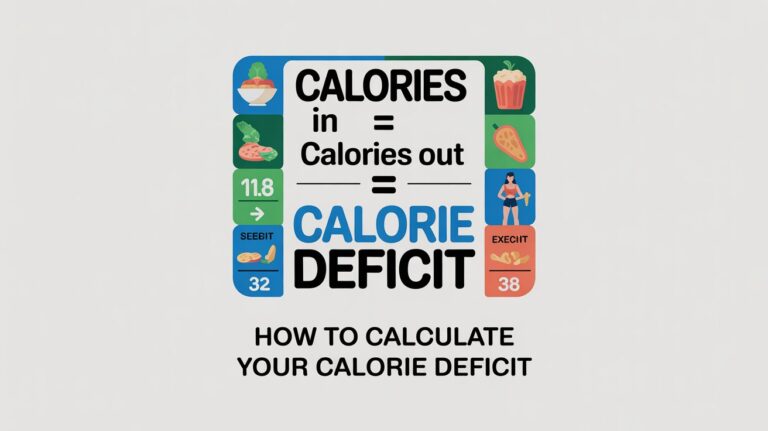
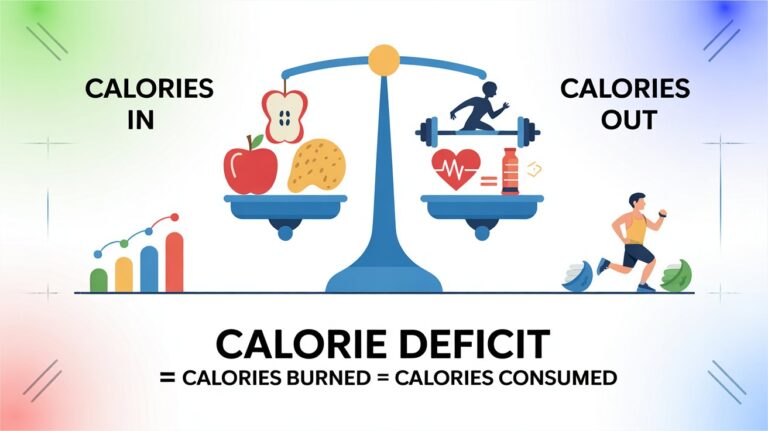
A 500-calorie deficit means you consume 500 calories less than your body burns each day.
| Term | Definition |
|---|---|
| TDEE | Total Daily Energy Expenditure (calories you burn) |
| 500 Calorie Deficit | Eating 500 calories less than your TDEE |
| Example | TDEE = 2,200 calories → Eat 1,700 calories daily |
If your body burns 2,200 calories per day (your TDEE), eating 1,700 calories creates a 500-calorie deficit. Your body makes up the difference by burning stored body fat.
Coach’s note: A 500-calorie deficit is not a diet. It is a mathematical target. You can reach it by eating less, moving more, or — ideally — a combination of both.
How Much Weight Will You Lose on a 500 Calorie Deficit?
Here is the math that matters.
The 7,700 Calorie Rule
| Fact | Explanation |
|---|---|
| 1 kg of body fat | Approximately 7,700 calories |
| 500 calorie daily deficit | 3,500 calorie weekly deficit |
| Weekly fat loss | 3,500 ÷ 7,700 = 0.45 kg (approx 1 lb) |
In simple terms: A 500-calorie deficit produces approximately 0.5kg (1lb) of fat loss per week.
Weight Loss Timeline Table
| Time Period | Weight Lost (approx) |
|---|---|
| 1 week | 0.5 kg (1 lb) |
| 1 month (4 weeks) | 2 kg (4.4 lb) |
| 2 months (8 weeks) | 4 kg (8.8 lb) |
| 3 months (12 weeks) | 6 kg (13.2 lb) |
| 6 months (24 weeks) | 12 kg (26.4 lb) |
| 12 months (52 weeks) | 24 kg (53 lb) |
Realistic Expectations by Starting Weight
| Starting Weight | Expected Weekly Loss (first 3 months) |
|---|---|
| 60-70 kg | 0.3-0.5 kg per week |
| 70-90 kg | 0.4-0.6 kg per week |
| 90-110 kg | 0.5-0.7 kg per week |
| 110+ kg | 0.5-0.8 kg per week |
Important notes:
- The first 1-2 weeks often show faster loss (water weight)
- Loss is not perfectly linear (some weeks you may lose nothing, then 1kg the next)
- As you get smaller, your TDEE drops — you may need to adjust
Why Is a 500 Calorie Deficit Considered the Gold Standard?
A 500-calorie deficit sits in the perfect sweet spot. Here is why researchers and health professionals recommend it.
1. It Produces Noticeable Results
Losing 0.5kg per week means losing 2kg per month. Over three months, that is 6kg — a visible, meaningful change. This keeps you motivated.
2. It Is Sustainable for Most People
A 500-calorie deficit typically allows you to eat enough food to feel satisfied. Compare this to a 1,000-calorie deficit, which often leaves people hungry, tired, and prone to binge eating.
3. It Preserves Muscle Mass
Research shows that moderate deficits (300-500 calories) result in primarily fat loss. Aggressive deficits (750-1,000+ calories) cause significantly more muscle loss.
| Deficit Size | Fat Loss % | Muscle Loss % |
|---|---|---|
| 300-500 calories | 85-95% | 5-15% |
| 500-750 calories | 75-85% | 15-25% |
| 750-1,000+ calories | 60-75% | 25-40% |
4. It Minimises Metabolic Adaptation
Aggressive deficits trigger “adaptive thermogenesis” — your body lowers its metabolic rate to conserve energy. A 500-calorie deficit causes minimal metabolic slowdown compared to larger deficits.
5. It Is Backed by Major Health Organisations
The NHS, British Dietetic Association, World Health Organization, and American College of Sports Medicine all recommend weight loss of 0.5-1kg per week — exactly what a 500-calorie deficit delivers.
How to Calculate Your 500 Calorie Deficit
Before you can create a 500-calorie deficit, you need to know your TDEE (maintenance calories).
Step 1: Calculate Your BMR
Use the Mifflin-St Jeor formula:
| Gender | Formula |
|---|---|
| Male | (10 × weight in kg) + (6.25 × height in cm) – (5 × age) + 5 |
| Female | (10 × weight in kg) + (6.25 × height in cm) – (5 × age) – 161 |
Step 2: Calculate Your TDEE
Multiply your BMR by your activity level:
| Activity Level | Multiplier |
|---|---|
| Sedentary (desk job, no exercise) | 1.2 |
| Lightly active (exercise 1-3 days/week) | 1.375 |
| Moderately active (exercise 3-5 days/week) | 1.55 |
| Very active (exercise 6-7 days/week) | 1.725 |
| Super active (physical job + daily exercise) | 1.9 |
Step 3: Subtract 500 Calories
| Formula |
|---|
| Daily Target = TDEE – 500 |
Worked Examples
Example 1: 35-year-old woman, 70kg, 165cm, lightly active
- BMR = 1,395 calories
- TDEE = 1,395 × 1.375 = 1,918 calories
- 500 deficit target = 1,418 calories/day
Example 2: 40-year-old man, 85kg, 180cm, moderately active
- BMR = 1,780 calories
- TDEE = 1,780 × 1.55 = 2,759 calories
- 500 deficit target = 2,259 calories/day
Safety Check
| Rule | Example 1 (Woman) | Example 2 (Man) |
|---|---|---|
| Above BMR? | 1,418 > 1,395 ✓ | 2,259 > 1,780 ✓ |
| Above minimum (1,200/1,500)? | 1,418 > 1,200 ✓ | 2,259 > 1,500 ✓ |
| Safe? | Yes | Yes |
3 Ways to Create a 500 Calorie Deficit
You have three options. Choose the one that fits your lifestyle.
Option 1: Diet Only (Eat 500 Less)
Reduce your food intake by 500 calories while keeping activity the same.
| Meal | Swap | Calories Saved |
|---|---|---|
| Breakfast | Skip the latte (120 cal) + swap pastry (300 cal) for Greek yoghurt (150 cal) | 270 |
| Lunch | Swap mayo chicken sandwich (550 cal) for grilled chicken salad (350 cal) | 200 |
| Dinner | Reduce rice portion from 200g to 100g | 130 |
| Snack | Skip the afternoon biscuit (80 cal) | 80 |
| Total | 680 saved |
Best for: People who prefer not to exercise or have limited time.
Option 2: Exercise Only (Burn 500 More)
Burn 500 additional calories through movement while eating the same.
| Activity | Duration (for 500 calories at 70kg) |
|---|---|
| Running (8km/h) | 35-40 minutes |
| Cycling (moderate pace) | 45-50 minutes |
| Swimming (vigorous) | 40-45 minutes |
| Walking (brisk pace) | 75-85 minutes |
| HIIT workout | 30-35 minutes |
| Strength training | 50-60 minutes |
| Rowing machine | 40-45 minutes |
Best for: People who enjoy exercise and do not want to reduce food intake.
Option 3: Combined Approach (Eat 250 Less + Burn 250 More)
This is the most sustainable approach for most people.
| Action | Calories |
|---|---|
| Skip the morning latte | -120 |
| Swap crisps for an apple at lunch | -150 |
| Walk 30 minutes at lunch | -130 |
| Choose grilled over fried for dinner | -100 |
| Total | -500 |
Best for: Most people — no single change feels drastic, and you get the benefits of both diet and movement.
What to Eat on a 500 Calorie Deficit
The quality of your calories matters. Here is a sample day of eating on a 1,500-calorie target (common for many women).
Sample Meal Plan (1,500 calories)
| Meal | Food | Calories |
|---|---|---|
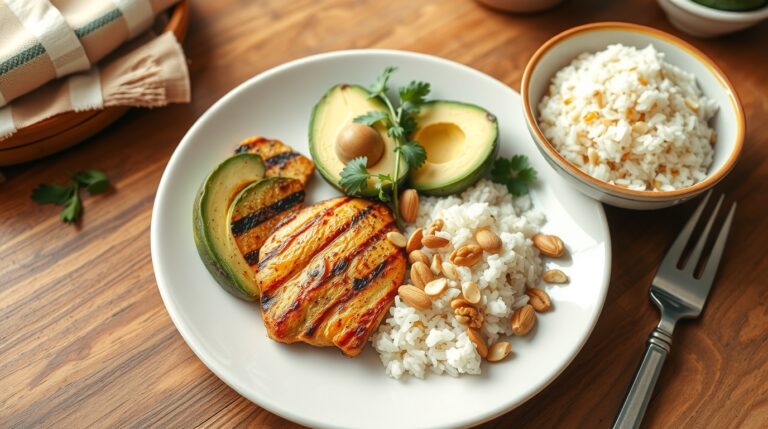
| Breakfast (350 cal) | 2 scrambled eggs + 1 slice whole grain toast + 100g berries | 350 |
| Lunch (400 cal) | 150g grilled chicken breast + large salad (mixed greens, cucumber, tomato) + 1 tbsp olive oil dressing | 400 |
| Afternoon Snack (150 cal) | 1 apple + 15g almond butter | 150 |
| Dinner (500 cal) | 150g baked salmon + 150g roasted sweet potato + 100g steamed broccoli | 500 |
| Evening Snack (100 cal) | 150g Greek yoghurt (plain) | 100 |
| Total | 1,500 |
Sample Meal Plan (2,200 calories for men/active women)
| Meal | Food | Calories |
|---|---|---|
| Breakfast (500 cal) | 3 scrambled eggs + 2 slices whole grain toast + 200g berries | 500 |
| Lunch (550 cal) | 180g grilled chicken breast + large salad + 1.5 tbsp olive oil + 100g quinoa | 550 |
| Afternoon Snack (250 cal) | 1 apple + 30g almond butter + 1 protein shake | 250 |
| Dinner (700 cal) | 180g baked salmon + 200g roasted sweet potato + 150g broccoli + 1 tbsp olive oil | 700 |
| Evening Snack (200 cal) | 200g Greek yoghurt + handful of nuts | 200 |
| Total | 2,200 |
Macronutrient Targets
On a 500-calorie deficit, prioritise protein to preserve muscle.
| Calorie Target | Protein (g) | Carbs (g) | Fat (g) |
|---|---|---|---|
| 1,500 calories | 110-130g | 130-160g | 40-50g |
| 1,800 calories | 130-150g | 160-200g | 50-60g |
| 2,200 calories | 150-180g | 200-250g | 60-75g |
500 Calorie Deficit Meal Ideas
Breakfast Options (300-400 calories)
| Meal | Calories | Protein |
|---|---|---|
| 2 eggs + 1 slice toast + 100g berries | 350 | 18g |
| 200g Greek yoghurt + 50g berries + 10g chia seeds | 320 | 22g |
| Overnight oats: 40g oats + 150ml almond milk + 1 scoop protein powder | 380 | 30g |
| Smoothie: 1 scoop protein + 150ml milk + 50g spinach + 50g banana | 340 | 28g |
Lunch Options (400-500 calories)
| Meal | Calories | Protein |
|---|---|---|
| 150g grilled chicken + large salad + 1 tbsp olive oil | 420 | 38g |
| Tuna salad: 1 can tuna + 2 tbsp Greek yoghurt + salad + 2 rice cakes | 440 | 42g |
| Lentil soup + 2 slices whole grain bread + 1 tbsp olive oil | 480 | 20g |
| 2 boiled eggs + avocado (half) + 2 rice cakes + cucumber | 460 | 20g |
Dinner Options (500-600 calories)
| Meal | Calories | Protein |
|---|---|---|
| 150g salmon + 150g sweet potato + 100g broccoli + 1 tbsp olive oil | 550 | 38g |
| 150g lean beef + 100g brown rice + stir-fry vegetables | 520 | 42g |
| 150g chicken thigh + 200g roasted vegetables + 1 tbsp olive oil | 500 | 35g |
| Tofu stir-fry: 200g firm tofu + vegetables + 1 tbsp soy sauce + 50g rice | 480 | 28g |
Snack Options (100-200 calories)
| Snack | Calories | Protein |
|---|---|---|
| 1 apple + 10g peanut butter | 150 | 4g |
| 150g Greek yoghurt | 100 | 10g |
| 1 hard-boiled egg | 70 | 6g |
| Handful of almonds (15g) | 90 | 3g |
| Protein shake (1 scoop with water) | 120 | 25g |
How Long Should You Stay on a 500 Calorie Deficit?
Most people benefit from 8-12 weeks of active dieting followed by a “diet break.”
Recommended Schedule
| Phase | Duration | Action |
|---|---|---|
| Diet phase | 8-12 weeks | Eat at 500-calorie deficit |
| Diet break | 1-2 weeks | Eat at maintenance (TDEE) |
| Repeat | As needed | Resume deficit if more weight to lose |
Why Take a Diet Break?
| Benefit | Explanation |
|---|---|
| Resets hunger hormones | Leptin (fullness) drops during dieting; maintenance restores it |
| Prevents metabolic adaptation | Gives your metabolism a chance to recover |
| Reduces diet fatigue | Mental break makes long-term adherence easier |
| Improves workout performance | More energy for training |
Signs You Need a Diet Break
- Weight loss has stalled for 3+ weeks despite accurate tracking
- Constant hunger or food obsession
- Low energy, poor sleep, irritability
- Loss of menstrual cycle (women) or low libido (men)
- Dreading meals or feeling deprived
Common Mistakes on a 500 Calorie Deficit
Mistake 1: Not Recounting After Weight Loss
Your TDEE drops as you lose weight. A 500-calorie deficit at 80kg is not a 500-calorie deficit at 70kg.
| Weight Lost | TDEE Drop | New Deficit if Eating Same |
|---|---|---|
| 5 kg | 50-75 calories | 425-450 deficit |
| 10 kg | 100-150 calories | 350-400 deficit |
| 15 kg | 150-225 calories | 275-350 deficit |
The fix: Recalculate your TDEE every 5kg lost. Adjust your intake down by 50-100 calories.
Mistake 2: Eating Back Exercise Calories
Your activity level already accounts for exercise. Eating back workout calories double-counts.
The fix: Do not add extra food on workout days. Trust your TDEE calculation.
Mistake 3: Underestimating Portions
A “handful” of nuts can be 200 calories. A “drizzle” of oil is 120 calories.
The fix: Measure portions for 1-2 weeks. You do not have to do this forever — just long enough to recalibrate.
Mistake 4: Ignoring Liquid Calories
Coffee drinks, alcohol, juice, and even milk in tea add up quickly.
| Drink | Calories |
|---|---|
| Latte (medium) | 120-180 |
| Pint of beer | 180-220 |
| Glass of wine (175ml) | 120-160 |
| Orange juice (250ml) | 110 |
| Regular soda (330ml) | 140 |
The fix: Track all drinks for one week. Replace high-calorie drinks with water, black coffee, or herbal tea.
Mistake 5: Cutting Too Low
Some people see “500 calorie deficit” and think “I will just eat 500 calories.” This is dangerous.
The fix: Your deficit is 500 below TDEE, not 500 total. For most people, that means eating 1,400-2,200 calories daily, not 500.
Who Should NOT Use a 500 Calorie Deficit?
A 500-calorie deficit is safe for most healthy adults, but not for everyone.
| Group | Reason | Alternative |
|---|---|---|
| BMI under 18.5 (underweight) | Should not be losing weight | See a GP or dietitian |
| Pregnant or breastfeeding | Increased energy needs | Consult your midwife |
| Under 18 years old | Growing bodies need more energy | See a paediatrician or dietitian |
| History of eating disorder | Deficit may trigger disordered behaviours | Work with a specialist |
| Certain medical conditions | Diabetes, thyroid disorders, PCOS may require modified approach | Consult your GP |
| Very active athletes | May need smaller deficit to fuel performance | Work with sports nutritionist |
500 Calorie Deficit Without Exercise: Is It Possible?
Yes — absolutely. You can create a 500-calorie deficit through diet alone.
| Approach | How | Weekly Loss |
|---|---|---|
| Diet only | Reduce food intake by 500 calories | 0.5 kg |
| Exercise only | Burn 500 calories through exercise | 0.5 kg |
| Combined | Reduce food by 250 + burn 250 | 0.5 kg |
The reality: Most people find diet-only easier than burning 500 calories through exercise (which takes 45-75 minutes daily). If you have mobility issues, a busy schedule, or simply dislike exercise, focus on your diet.
500 Calorie Deficit Success Tips
Track Everything for Two Weeks
You cannot manage what you do not measure. Track every calorie for at least 14 days. You will likely discover hidden calories you did not know existed.
Prioritise Protein
Protein preserves muscle and controls hunger. Aim for 1.6-2.2g per kg of body weight. For a 70kg person, that is 112-154g daily.
Drink Water Before Meals
Drink 500ml (2 cups) of water 15-20 minutes before eating. Research shows this reduces calorie intake by 44-88 calories per meal.
Eat Volumetrically
Fill half your plate with low-calorie vegetables. They add volume and fibre without many calories.
| Vegetable | Calories per 100g |
|---|---|
| Broccoli | 34 |
| Spinach | 23 |
| Cucumber | 15 |
| Bell peppers | 31 |
| Cauliflower | 25 |
Do Not Drink Your Calories
Stick to water, black coffee, and herbal tea. Liquid calories do not trigger fullness signals the way solid food does.
Plan Your Treats
Deprivation leads to binge eating. Schedule small treats (100-200 calories) into your daily target. A square of dark chocolate, a small cookie, or a few crisps can prevent feelings of restriction.
Get Enough Sleep
Poor sleep increases ghrelin (hunger hormone) and decreases leptin (fullness hormone). Aim for 7-9 hours per night.
Your 7-Day Action Plan for a 500 Calorie Deficit
| Day | Action |
|---|---|
| Day 1 | Calculate your TDEE using the formulas above or our calculator |
| Day 2 | Subtract 500 to find your daily target |
| Day 3 | Plan your meals around your target, prioritising protein |
| Day 4 | Start tracking everything you eat and drink |
| Day 5-7 | Eat at your target consistently |
| Week 2 | Weigh yourself; if you lost 0.5kg, keep going |
| Week 3-12 | Maintain the deficit; recalculate every 5kg lost |
| Week 12 | Take a 1-2 week diet break at maintenance |
The Bottom Line: A 500 Calorie Deficit Works
A 500-calorie deficit is not a fad diet. It is not a detox or a cleanse. It is simple, proven math.
Eat 500 calories less than your body burns each day. Lose approximately 0.5kg per week. Repeat until you reach your goal.
No gimmicks. No starvation. Just consistency.
You know your numbers. You have the tools. Now take action.
Your next step: Use the calculator to find your TDEE and your 500-calorie deficit target. Then start today.
🔥 500 Calorie Deficit: Frequently Asked Questions
A 500-calorie deficit produces approximately 0.5kg (1lb) of fat loss per week. Here is the math:
500 calorie daily deficit × 7 days = 3,500 weekly deficit
3,500 ÷ 7,700 = 0.45 kg (approx 0.5 kg) per week
| Time Period | Weight Lost (approx) |
|---|---|
| 1 week | 0.5 kg (1 lb) |
| 1 month (4 weeks) | 2 kg (4.4 lb) |
| 2 months (8 weeks) | 4 kg (8.8 lb) |
| 3 months (12 weeks) | 6 kg (13.2 lb) |
| 6 months (24 weeks) | 12 kg (26.4 lb) |
Calculating your 500-calorie deficit takes three steps:
Step 1: Calculate your BMR using Mifflin-St Jeor:
Female: (10 × weight in kg) + (6.25 × height in cm) – (5 × age) – 161
Step 2: Calculate your TDEE by multiplying BMR by activity level:
| Activity Level | Multiplier |
|---|---|
| Sedentary (desk job, no exercise) | 1.2 |
| Lightly active (exercise 1-3 days/week) | 1.375 |
| Moderately active (exercise 3-5 days/week) | 1.55 |
| Very active (exercise 6-7 days/week) | 1.725 |
| Super active (physical job + daily exercise) | 1.9 |
Step 3: Subtract 500 from your TDEE
Example: A 35-year-old woman, 70kg, 165cm, lightly active has TDEE of 1,918. Her 500 deficit target is 1,418 calories/day.
Here is a sample day at 1,500 calories (common for many women on a 500 deficit):
| Meal | Food | Calories |
|---|---|---|
| Breakfast | 2 scrambled eggs + 1 slice whole grain toast + 100g berries | 350 |
| Lunch | 150g grilled chicken + large salad + 1 tbsp olive oil | 400 |
| Snack | 1 apple + 15g almond butter | 150 |
| Dinner | 150g baked salmon + 150g sweet potato + 100g broccoli | 500 |
| Evening | 150g Greek yoghurt | 100 |
| Total | 1,500 |
No — exercise is not required. You can create a 500-calorie deficit through diet alone. However, exercise offers benefits:
| Approach | How | Weekly Loss |
|---|---|---|
| Diet only | Eat 500 fewer calories daily | 0.5 kg |
| Exercise only | Burn 500 calories daily through exercise | 0.5 kg |
| Combined | Eat 250 less + burn 250 through movement | 0.5 kg |
For healthy adults with a BMI between 18.5-30, a 500-calorie deficit is safe and NHS-aligned. However, some groups should NOT use a 500-calorie deficit:
| Group | Reason | Alternative |
|---|---|---|
| BMI under 18.5 (underweight) | Should not be losing weight | See a GP or dietitian |
| Pregnant or breastfeeding | Increased energy needs | Consult your midwife |
| Under 18 years old | Growing bodies need more energy | See a paediatrician |
| History of eating disorder | May trigger disordered behaviours | Work with a specialist |
| Certain medical conditions | Diabetes, thyroid disorders, PCOS | Consult your GP |
Most people benefit from 8-12 weeks of active dieting followed by a 1-2 week “diet break” at maintenance calories.
| Phase | Duration | Action |
|---|---|---|
| Diet phase | 8-12 weeks | Eat at 500-calorie deficit |
| Diet break | 1-2 weeks | Eat at maintenance (TDEE) |
| Repeat | As needed | Resume deficit if more weight to lose |
Signs you need a diet break: Weight loss stalled for 3+ weeks, constant hunger, low energy, poor sleep, or dreading meals.
If your weight loss has stalled, here are the most common reasons:
- You haven’t recalculated: Your TDEE drops as you lose weight. A 500 deficit at 80kg is not a 500 deficit at 70kg.
- Metabolic adaptation: After 4-8 weeks, your body burns 5-15% fewer calories as a survival mechanism.
- Tracking errors: “Just a bite” calories add up to 200-400 daily.
- Water retention: Hormones, salt, or new exercise can mask fat loss for 1-2 weeks.
| Weight Lost | TDEE Drop | Actual Deficit if Eating Same |
|---|---|---|
| 5 kg | 50-75 calories | 425-450 deficit |
| 10 kg | 100-150 calories | 350-400 deficit |
| 15 kg | 150-225 calories | 275-350 deficit |
Protein is crucial on a 500-calorie deficit to preserve muscle and control hunger. Use these targets:
| Activity Level | Protein per kg body weight | Example (70kg person) |
|---|---|---|
| Sedentary weight loss | 1.2-1.6 g/kg | 84-112g per day |
| Active weight loss | 1.6-2.2 g/kg | 112-154g per day |
| Athlete cutting weight | 2.2-2.6 g/kg | 154-182g per day |
Best protein sources: Chicken breast, turkey, lean beef, fish, eggs, Greek yoghurt, cottage cheese, tofu, lentils, and protein powder.
Yes, but with caution. Alcohol has 7 calories per gram — almost as much as fat (9 calories).
| Drink | Calories | % of 500 Deficit |
|---|---|---|
| Pint of beer (4-5%) | 180-220 | 36-44% |
| Glass of wine (175ml) | 120-160 | 24-32% |
| Single spirit + diet mixer | 60-80 | 12-16% |
| Cocktail (Margarita) | 300-500 | 60-100% |
1. Lowers inhibitions → makes overeating more likely
2. Disrupts sleep → increases hunger hormones the next day
3. Prioritises alcohol metabolism → fat burning pauses while alcohol is processed
Our recommendation: Limit to 1-2 drinks weekly, factor them into your calories, and choose lower-calorie options (spirit + diet mixer, light beer).
Aim for 2-3 litres (8-12 cups) of water per day. Here is why water matters on a deficit:
- Controls hunger: Thirst is often mistaken for hunger
- Supports metabolism: Dehydration slows calorie burn by 2-3%
- Aids fat breakdown: Water is required for lipolysis (burning fat)
- Prevents constipation: Common when increasing protein
- Improves exercise performance: Even mild dehydration reduces output
Easy ways to increase water intake: Carry a refillable bottle, set hourly reminders, add lemon or cucumber for flavour, drink a glass with every meal.