How to Calculate a Calorie Deficit: The Step-by-Step Guide to Accurate Weight Loss
You have heard the phrase “calories in, calories out” more times than you can count. But knowing the concept and knowing how to calculate it for your unique body are two very different things.
Here is the reality: most people trying to lose weight are guessing. They pick a random number like 1,500 or 2,000 calories because someone online said so. Then they get frustrated when it does not work.
That stops today.
In this guide, you will learn exactly how to calculate your personal calorie deficit using science-backed formulas. No more guessing. No more cookie-cutter advice. Just a clear, step-by-step system that works for your body, your lifestyle, and your goals.
In this guide, you will learn:
- The simple math behind every calorie deficit
- How to calculate your BMR and TDEE with precision
- Which activity level actually fits your life
- How to choose the right deficit size for your goals
- When and how to adjust your numbers as you lose weight
Let us get started.
The Simple Math Behind Every Calorie Deficit
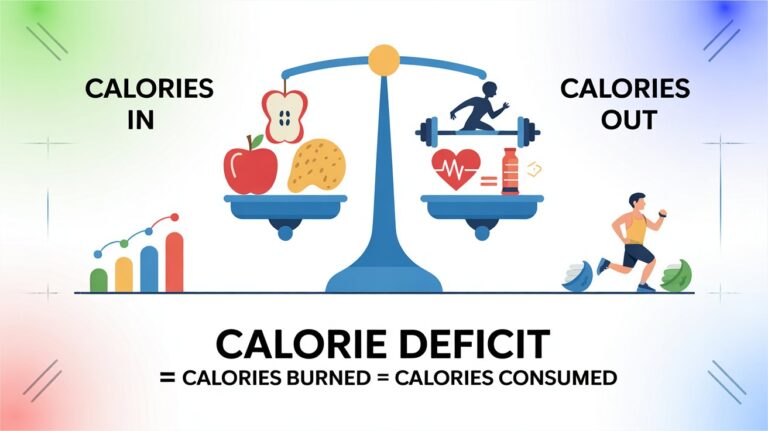
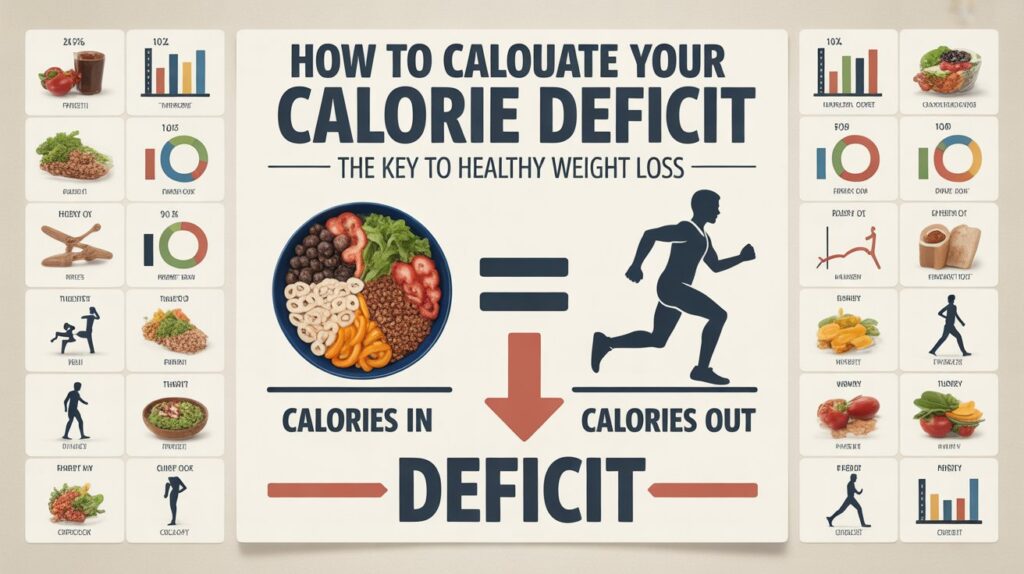
Before we dive into calculations, you need to understand the fundamental equation. It is simple enough to fit on a napkin:
| Equation | Meaning |
|---|---|
| Calories In | Everything you eat and drink |
| Calories Out | Everything your body burns (BMR + activity + digestion) |
| Calories In < Calories Out | Calorie deficit = weight loss |
| Calories In > Calories Out | Calorie surplus = weight gain |
| Calories In = Calories Out | Maintenance = weight stability |
Coach’s note: This is not a theory. It is the first law of thermodynamics applied to the human body. Every diet that has ever worked — from keto to vegan to intermittent fasting — works because it helps you eat fewer calories than you burn.
Your job is not to figure out a “magic diet.” Your job is to figure out your numbers.
Step 1: Calculate Your BMR (Basal Metabolic Rate)
Your BMR is the number of calories your body burns at complete rest — just to keep you alive. Think of it as your body’s idling speed.
The Most Accurate Formula: Mifflin-St Jeor
The Mifflin-St Jeor equation is widely considered the most accurate formula for estimating BMR. A 2018 study in the Journal of the Academy of Nutrition and Dietetics confirmed it outperforms the older Harris-Benedict equation by approximately 12%.
| Gender | Formula |
|---|---|
| Male | (10 × weight in kg) + (6.25 × height in cm) – (5 × age) + 5 |
| Female | (10 × weight in kg) + (6.25 × height in cm) – (5 × age) – 161 |
Worked Examples
Example 1: A 35-year-old woman, 70kg, 165cm
| Step | Calculation | Result |
|---|---|---|
| 10 × weight | 10 × 70 | 700 |
| 6.25 × height | 6.25 × 165 | 1,031.25 |
| 5 × age | 5 × 35 | 175 |
| Add/Subtract | 700 + 1,031.25 – 175 – 161 | 1,395.25 |
| BMR | 1,395 calories/day |
Example 2: A 40-year-old man, 85kg, 180cm
| Step | Calculation | Result |
|---|---|---|
| 10 × weight | 10 × 85 | 850 |
| 6.25 × height | 6.25 × 180 | 1,125 |
| 5 × age | 5 × 40 | 200 |
| Add/Subtract | 850 + 1,125 – 200 + 5 | 1,780 |
| BMR | 1,780 calories/day |
The Optional Katch-McArdle Formula (If You Know Your Body Fat %)
If you know your body fat percentage, the Katch-McArdle formula is even more accurate because it accounts for lean mass:
| Formula | Calculation |
|---|---|
| Katch-McArdle | 370 + (21.6 × lean mass in kg) |
| Lean mass | Body weight in kg × (1 – body fat percentage ÷ 100) |
Example: 70kg woman with 28% body fat
- Lean mass = 70 × (1 – 0.28) = 50.4 kg
- BMR = 370 + (21.6 × 50.4) = 370 + 1,088.6 = 1,459 calories/day
The Quick Estimate (If You Cannot Do Math Right Now)
If you need a rough starting point, use these averages:
| Group | Average BMR Range |
|---|---|
| Women (average weight 70kg) | 1,300 – 1,500 calories/day |
| Men (average weight 80kg) | 1,600 – 1,800 calories/day |
Important: These are rough averages. Use the formula above for accuracy.
Step 2: Calculate Your TDEE (Total Daily Energy Expenditure)
Your BMR is only part of the picture. You also move, walk, fidget, exercise, and digest food. Your TDEE includes all of that.
The Activity Multiplier
Multiply your BMR by the activity factor that best matches your lifestyle.
| Activity Level | Multiplier | What It Means | Example (BMR 1,395) |
|---|---|---|---|
| Sedentary | BMR × 1.2 | Desk job, little or no exercise, mostly sitting | 1,674 calories |
| Lightly active | BMR × 1.375 | Light exercise 1-3 days/week, walking occasionally | 1,918 calories |
| Moderately active | BMR × 1.55 | Moderate exercise 3-5 days/week, active job or regular movement | 2,162 calories |
| Very active | BMR × 1.725 | Hard exercise 6-7 days/week, physical job or training for event | 2,406 calories |
| Super active | BMR × 1.9 | Physical job (construction, farming) + daily intense training | 2,650 calories |
How to Choose Your Activity Level Honestly
Most people overestimate their activity level. Here is how to choose accurately:
| If This Describes You | Choose |
|---|---|
| Office job, drive everywhere, no formal exercise, under 5,000 steps daily | Sedentary |
| Office job, but exercise 1-3 times weekly OR walk 5,000-7,500 steps daily | Lightly active |
| Exercise 3-5 times weekly AND get 7,500-10,000 steps daily | Moderately active |
| Exercise 6-7 times weekly AND get 10,000-15,000 steps daily | Very active |
| Physical job (warehouse, nursing, construction) AND exercise most days | Super active |
Coach’s note: When in doubt, choose the lower activity level. It is better to start slightly lower and adjust up than to overestimate and wonder why you are not losing weight.
Worked Examples (Continuing from Above)
Example 1: 35-year-old woman, BMR 1,395
| Activity Level | TDEE Calculation | Result |
|---|---|---|
| Sedentary | 1,395 × 1.2 | 1,674 calories |
| Lightly active | 1,395 × 1.375 | 1,918 calories |
| Moderately active | 1,395 × 1.55 | 2,162 calories |
| Very active | 1,395 × 1.725 | 2,406 calories |
If this woman has an office job but walks 30 minutes 4 times per week, she is lightly active. Her TDEE is approximately 1,918 calories.
Example 2: 40-year-old man, BMR 1,780
| Activity Level | TDEE Calculation | Result |
|---|---|---|
| Sedentary | 1,780 × 1.2 | 2,136 calories |
| Lightly active | 1,780 × 1.375 | 2,448 calories |
| Moderately active | 1,780 × 1.55 | 2,759 calories |
| Very active | 1,780 × 1.725 | 3,071 calories |
If this man works a desk job but lifts weights 4 times per week, he is moderately active. His TDEE is approximately 2,759 calories.
Step 3: Choose Your Calorie Deficit Size
Now that you know your TDEE (maintenance calories), you need to decide how large of a deficit to create.
The Safe Deficit Range
| Deficit Size | Weekly Loss | Best For |
|---|---|---|
| 250 calories/day | 0.25 kg (0.5 lb) | Beginners, close to goal weight, minimal hunger |
| 500 calories/day | 0.5 kg (1 lb) | Most people — the sweet spot |
| 750 calories/day | 0.75 kg (1.5 lb) | Aggressive but manageable with high protein |
| 1000 calories/day | 1 kg (2 lb) | Very aggressive — short-term only, medical supervision recommended |
The Safety Rules
| Group | Absolute Minimum | Why |
|---|---|---|
| Women | 1,200 calories/day | Below this risks nutrient deficiencies, muscle loss, hormonal disruption |
| Men | 1,500 calories/day | Below this risks metabolic slowdown, fatigue, gallstones |
Golden rule: Your target intake should never fall below your BMR for extended periods. If your calculated deficit would push you below your BMR, choose a smaller deficit or extend your timeline.
How to Choose Your Deficit
| If This Describes You | Recommended Deficit |
|---|---|
| First time tracking calories | 300 calories (gentle start) |
| Less than 5kg to lose | 300-400 calories |
| 5-15kg to lose | 500 calories |
| 15kg+ to lose | 500-750 calories (initially) |
| Very active athlete cutting weight | 500 calories with high protein |
| Medical condition or history of disordered eating | Consult professional |
Step 4: Calculate Your Daily Calorie Target
This is the number you have been waiting for. Your daily calorie target is:
| Formula |
|---|
| TDEE – Deficit = Daily Calorie Target |
Worked Examples
Example 1: 35-year-old woman, lightly active
- TDEE = 1,918 calories
- Deficit = 500 calories (moderate weight loss)
- Daily target = 1,918 – 500 = 1,418 calories
| Check | Is it safe? |
|---|---|
| Above BMR? | Yes (1,418 > 1,395) |
| Above minimum (1,200)? | Yes |
| Verdict | Safe and effective |
Example 2: 40-year-old man, moderately active
- TDEE = 2,759 calories
- Deficit = 500 calories
- Daily target = 2,759 – 500 = 2,259 calories
| Check | Is it safe? |
|---|---|
| Above BMR? | Yes (2,259 > 1,780) |
| Above minimum (1,500)? | Yes |
| Verdict | Safe and effective |
Example 3: Sedentary woman with low TDEE
- TDEE = 1,674 calories
- Goal = lose 0.5kg per week (500 calorie deficit)
- Calculated target = 1,674 – 500 = 1,174 calories
| Check | Is it safe? |
|---|---|
| Above BMR? | No (1,174 < 1,395) |
| Above minimum (1,200)? | No |
| Verdict | Unsafe — adjust deficit |
Adjustment for Example 3:
- Maximum safe deficit = TDEE – 1,200 = 1,674 – 1,200 = 474 calories
- Realistic weekly loss = 474 ÷ 7,700 × 7 = 0.43 kg per week
- Daily target = 1,200 calories
- Timeline extension needed: losing 10kg would take approximately 23 weeks instead of 20 weeks
Step 5: Calculate Your Total Deficit Needed
To reach your goal weight, you need to know the total calorie deficit required.
The Formula
| Formula |
|---|
| 1 kg of body fat = approximately 7,700 calories |
| Calculation | Formula |
|---|---|
| Total deficit needed | (Current weight – Goal weight in kg) × 7,700 |
| Time needed (weeks) | Total deficit needed ÷ (Daily deficit × 7) |
Worked Examples
Example: Woman wants to lose 10kg with a 500 calorie daily deficit
| Calculation | Result |
|---|---|
| Total deficit needed | 10 kg × 7,700 = 77,000 calories |
| Weekly deficit | 500 × 7 = 3,500 calories |
| Weeks needed | 77,000 ÷ 3,500 = 22 weeks |
Example: Man wants to lose 15kg with a 500 calorie daily deficit
| Calculation | Result |
|---|---|
| Total deficit needed | 15 kg × 7,700 = 115,500 calories |
| Weekly deficit | 500 × 7 = 3,500 calories |
| Weeks needed | 115,500 ÷ 3,500 = 33 weeks |
Quick Reference Table: Time to Lose Weight
| Total to Lose | 250 deficit (0.25kg/week) | 500 deficit (0.5kg/week) | 750 deficit (0.75kg/week) |
|---|---|---|---|
| 2.5 kg (5.5 lbs) | 10 weeks | 5 weeks | 3-4 weeks |
| 5 kg (11 lbs) | 20 weeks | 10 weeks | 7 weeks |
| 10 kg (22 lbs) | 40 weeks | 20 weeks | 13-14 weeks |
| 15 kg (33 lbs) | 60 weeks | 30 weeks | 20 weeks |
| 20 kg (44 lbs) | 80 weeks | 40 weeks | 27 weeks |
The 2-Week Real-TDEE Testing Protocol
Calculators give you an estimate. Real-world data gives you the truth. Here is how to validate your numbers.
Week 1: Baseline
| Day | Action |
|---|---|
| Days 1-7 | Eat at your calculated TDEE (maintenance) |
| Daily | Track everything you eat and drink |
| Daily | Weigh yourself every morning (same time, same scale, after bathroom) |
| End of week | Calculate your average weight for Week 1 |
Week 2: Test
| Day | Action |
|---|---|
| Days 8-14 | Continue eating at calculated TDEE |
| Daily | Track everything |
| Daily | Weigh yourself every morning |
| End of week | Calculate your average weight for Week 2 |
Interpret Your Results
| Average Weight Change | What It Means | Action |
|---|---|---|
| Stayed the same (±0.2kg) | Your TDEE is accurate | Use calculated numbers |
| Lost 0.5kg+ | Your TDEE is higher than calculated | Add 150-200 calories to TDEE |
| Gained 0.5kg+ | Your TDEE is lower than calculated | Subtract 150-200 calories from TDEE |
Why this works: Your scale does not lie. If you eat at what you think is maintenance but lose weight, your actual maintenance is higher. Adjust and retest if needed.
How to Calculate a Calorie Deficit for Weight Loss: Summary Table
Here is everything in one place:
| Step | What to Do | Formula |
|---|---|---|
| 1 | Calculate BMR | Mifflin-St Jeor (see formulas above) |
| 2 | Choose activity multiplier | 1.2 to 1.9 based on your lifestyle |
| 3 | Calculate TDEE | BMR × Activity multiplier |
| 4 | Choose deficit | 300-500 calories for most people |
| 5 | Calculate daily target | TDEE – Deficit |
| 6 | Check safety | Target ≥ BMR and ≥ 1,200/1,500 minimums |
| 7 | Calculate timeline | (Goal loss in kg × 7,700) ÷ (Deficit × 7) |
How to Adjust Your Deficit as You Lose Weight
Your calorie needs change as your body changes. Here is exactly when and how to adjust.
When to Recalculate
| Change | Action |
|---|---|
| Every 5kg (11lbs) lost | Mandatory recalculation |
| Every 4-6 weeks | Recommended check-in |
| Plateau lasting 3+ weeks | Immediate recalculation |
| Activity level changes significantly | Immediate recalculation |
What Changes
| Weight Lost | TDEE Drop (Approx.) | Deficit Adjustment Needed |
|---|---|---|
| 5 kg (11 lbs) | 50-75 calories/day | Reduce intake by 50 calories OR add 10 min walking |
| 10 kg (22 lbs) | 100-150 calories/day | Reduce intake by 100 calories |
| 15 kg (33 lbs) | 150-225 calories/day | Reduce intake by 150 calories |
| 20 kg (44 lbs) | 200-300 calories/day | Recalculate fully — significant change |
Example Adjustment
Starting point (80kg woman):
- BMR = 1,500
- TDEE = 2,000 (lightly active)
- Deficit = 500
- Daily target = 1,500 calories
After losing 10kg (now 70kg):
- Recalculate BMR = 1,395 (lower!)
- Recalculate TDEE = 1,918 (lightly active)
- Same deficit of 500 = 1,418 daily target
The difference: She must eat 82 fewer calories per day than when she started. If she kept eating 1,500 calories, her deficit would only be 418 calories — slowing her progress by 15%.
Common Calculation Mistakes (And How to Avoid Them)
Mistake 1: Using the Wrong Formula
The Harris-Benedict equation (developed in 1919) is still used by many calculators. It overestimates BMR by 5-15% for most people.
The fix: Use Mifflin-St Jeor. It is validated by modern research.
Mistake 2: Overestimating Activity Level
“I walked for 20 minutes twice this week — I am very active!” No. Overestimating activity adds hundreds of calories to your TDEE that do not exist.
The fix: Be brutally honest. When in doubt, choose the lower activity level.
Mistake 3: Forgetting to Recalculate
Your TDEE at 80kg is not the same as your TDEE at 70kg. If you do not recalculate, your deficit shrinks and your weight loss slows.
The fix: Set a calendar reminder to recalculate every 5kg lost or every 6 weeks.
Mistake 4: Ignoring the BMR Floor
Eating below your BMR for weeks or months triggers metabolic adaptation, muscle loss, and hormonal disruption.
The fix: If your calculated target is below your BMR, choose a smaller deficit. Weight loss is a marathon, not a sprint.
Mistake 5: Using Inaccurate Measurements
Guessing your weight, height, or age leads to inaccurate calculations.
The fix: Use a scale, a tape measure, and your actual birth date. No rounding up or down.
How to Use a Calorie Deficit Calculator (Instead of Doing It Manually)
While understanding the math is valuable, you do not need to do it manually every time. A good calorie deficit calculator automates the entire process.
What Our Calculator Does For You
| Feature | Benefit |
|---|---|
| Mifflin-St Jeor formula | Most accurate BMR calculation |
| Activity multiplier selection | Clear descriptions to choose correctly |
| Optional body fat % | Katch-McArdle for athletes |
| Safety checks | Warns if target is unsafe |
| Goal timeline | Calculates how long it will take |
| Weekly projections | Shows expected weight each week |
| PDF report | Download and share |
How to Use Our Calculator
- Enter your gender, age, weight, height
- Select your activity level honestly
- Enter your goal weight and desired timeline
- Click calculate
- Review your daily target, macros, and weekly projection
- Download your PDF report for reference
Your 7-Day Action Plan
Ready to put this into action? Here is exactly what to do.
Day 1: Gather your data
- Weigh yourself (first thing in the morning, after bathroom)
- Measure your height
- Confirm your age
Day 2: Calculate your numbers
- Use the formulas above or our calculator
- Write down your BMR, TDEE, and daily target
Day 3: Plan your meals
- Based on your daily target, plan 3-4 meals
- Prioritise protein at every meal
- Include vegetables and fibre
Day 4: Start tracking
- Download a tracking app
- Track everything you eat and drink
- Do not change anything yet — just observe
Day 5-7: Hit your target
- Eat at your calculated daily target
- Track everything
- Drink 2-3 litres of water
Week 2: Assess and adjust
- Weigh yourself (same conditions as Day 1)
- Calculate your average weekly loss
- If you lost 0.5-1kg, keep going
- If not, adjust your target by 100 calories up or down
Long-term: Recalculate every 5kg lost
The Bottom Line: You Now Know Exactly How to Calculate Your Calorie Deficit
You have the formulas. You have the multipliers. You have the safety rules. You have the adjustment schedule.
Calculating a calorie deficit is not complicated — but it does require honesty. Honest about your activity level. Honest about your tracking. Honest about your timeline.
Start with a 500-calorie deficit. Track consistently for two weeks. Adjust based on real-world results. Recalculate every 5kg lost.
That is it. That is the system.
Your body is not a mystery. It runs on math. And now you know exactly how to do the math.
Your next step: Use the calculator to get your personalized numbers. Then take action. Today.
📐 Calorie Deficit Calculation: Frequently Asked Questions
The complete formula has three steps:
Step 2: TDEE = BMR × Activity Multiplier (1.2 to 1.9)
Step 3: Deficit Target = TDEE – 500 (for 0.5kg weekly loss)
For example, a 35-year-old woman weighing 70kg at 165cm with light activity:
- BMR = 1,395 calories
- TDEE = 1,395 × 1.375 = 1,918 calories
- Deficit target = 1,918 – 500 = 1,418 calories daily
TDEE (Total Daily Energy Expenditure) is your BMR multiplied by an activity factor. Choose honestly:
| Activity Level | Multiplier | Example (BMR 1,400) |
|---|---|---|
| Sedentary (desk job, no exercise) | 1.2 | 1,680 calories |
| Lightly active (exercise 1-3 days/week) | 1.375 | 1,925 calories |
| Moderately active (exercise 3-5 days/week) | 1.55 | 2,170 calories |
| Very active (exercise 6-7 days/week) | 1.725 | 2,415 calories |
| Super active (physical job + daily exercise) | 1.9 | 2,660 calories |
A safe calorie deficit ranges from 300 to 750 calories below your TDEE. The sweet spot for most people is 500 calories, yielding 0.5kg (1lb) loss per week.
| Deficit Size | Weekly Loss | Best For |
|---|---|---|
| 300-400 calories | 0.3-0.4 kg | Beginners, close to goal weight |
| 500 calories | 0.5 kg | Most people — sustainable and effective |
| 600-750 calories | 0.6-0.8 kg | Aggressive but manageable with high protein |
| 1000+ calories | 1+ kg | Very aggressive — medical supervision recommended |
Use the 7,700 calorie rule: 1kg of body fat = approximately 7,700 calories.
Example calculation: A woman wants to lose 10kg with a 500-calorie daily deficit.
- Total deficit needed: 10 × 7,700 = 77,000 calories
- Weekly deficit: 500 × 7 = 3,500 calories
- Weeks needed: 77,000 ÷ 3,500 = 22 weeks (about 5.5 months)
| Weight to Lose | 500 Deficit (0.5kg/week) | 750 Deficit (0.75kg/week) |
|---|---|---|
| 5 kg | 10 weeks | 7 weeks |
| 10 kg | 20 weeks | 13-14 weeks |
| 15 kg | 30 weeks | 20 weeks |
| 20 kg | 40 weeks | 27 weeks |
Your calorie needs change as your body changes. Recalculate at these milestones:
| Trigger | Why | Action |
|---|---|---|
| Every 5kg (11lbs) lost | Your smaller body burns fewer calories | Reduce intake by 50-100 calories or recalculate fully |
| Every 4-6 weeks | Metabolic adaptation may have occurred | Quick check-in with your scale trends |
| Plateau lasting 3+ weeks | Your deficit may have shrunk to zero | Immediate recalculation needed |
| Activity level changes significantly | New job, injury, marathon training | Recalculate with new activity multiplier |
The Mifflin-St Jeor equation is the most accurate BMR formula validated by modern research. A 2018 study in the Journal of the Academy of Nutrition and Dietetics confirmed it outperforms the older Harris-Benedict equation by approximately 12%.
👩 Female: (10 × weight in kg) + (6.25 × height in cm) – (5 × age) – 161
Worked example (40-year-old man, 85kg, 180cm):
- 10 × 85 = 850
- 6.25 × 180 = 1,125
- 5 × 40 = 200
- 850 + 1,125 – 200 + 5 = 1,780 calories/day BMR
Both approaches work, but a good calculator saves time and reduces errors. Here is the comparison:
| Feature | Manual Calculation | Calculator |
|---|---|---|
| Time required | 5-10 minutes with risk of math errors | 2 seconds |
| Formula accuracy | Depends on using correct formula (many use outdated Harris-Benedict) | Mifflin-St Jeor (most accurate) |
| Activity multiplier selection | Easy to overestimate | Clear descriptions for each level |
| Safety checks | You must remember minimums (1,200/1,500) | Automatic warnings for unsafe deficits |
| Weekly projections | Manual calculation | Instant chart and table |
No — this is the most common calculation mistake.
Your TDEE already includes your activity level. When you selected “moderately active” (exercise 3-5 days/week), we multiplied your BMR by 1.55 — meaning your exercise calories are already factored into your daily target.
The only exception: Endurance athletes burning 800+ calories in a single session (marathon training, 2+ hour bike rides) may need to add back 50% of estimated burn. For everyone else, trust the TDEE calculation.
When you hit a plateau, your current deficit has likely shrunk or disappeared. Here is how to recalculate:
Step 1: Recalculate your current TDEE
Use your current weight (not your starting weight). Your smaller body burns fewer calories.
Step 2: Compare to your current intake
If your current intake is now equal to your new TDEE, you are eating at maintenance — no deficit.
Step 3: Create a new deficit
Subtract 300-500 calories from your new TDEE.
Now at 70kg with new TDEE 1,850. Eating 1,500 is only a 350 deficit.
New target: 1,850 – 500 = 1,350 calories to restart 0.5kg/week loss.
Protein is not part of your deficit calculation, but it is essential for preserving muscle while in a deficit. Use these targets:
| Activity Level | Protein per kg body weight | Example (70kg person) |
|---|---|---|
| Sedentary weight loss | 1.2-1.6 g/kg | 84-112g per day |
| Active weight loss | 1.6-2.2 g/kg | 112-154g per day |
| Athlete cutting weight | 2.2-2.6 g/kg | 154-182g per day |
How to calculate your protein calories: Protein has 4 calories per gram. If you need 140g of protein daily, that accounts for 560 of your total calorie target.